How One Studio Made Google Its #1 Growth Channel in 90 Days
Most video platforms give creators everything except the one thing that brings new people in on autopilot: a page Google can rank. Uscreen and Vimeo OTT host your videos beautifully — but they have no blog, no article pages, nothing for search engines to index. So your only "discovery" becomes whatever you pay for in ads. Here is what happens when a studio moves to a platform that ships a real editorial surface.
From near-zero to the #1 discovery channel in 90 days
We looked at 90 days of Google Analytics for a boutique yoga studio (about 500 members) running video, subscriptions, and a blog on a single CrocOTT domain. Over the window, organic search climbed from a sliver of traffic to the site's number-one discovery channel — 36% of all sessions.
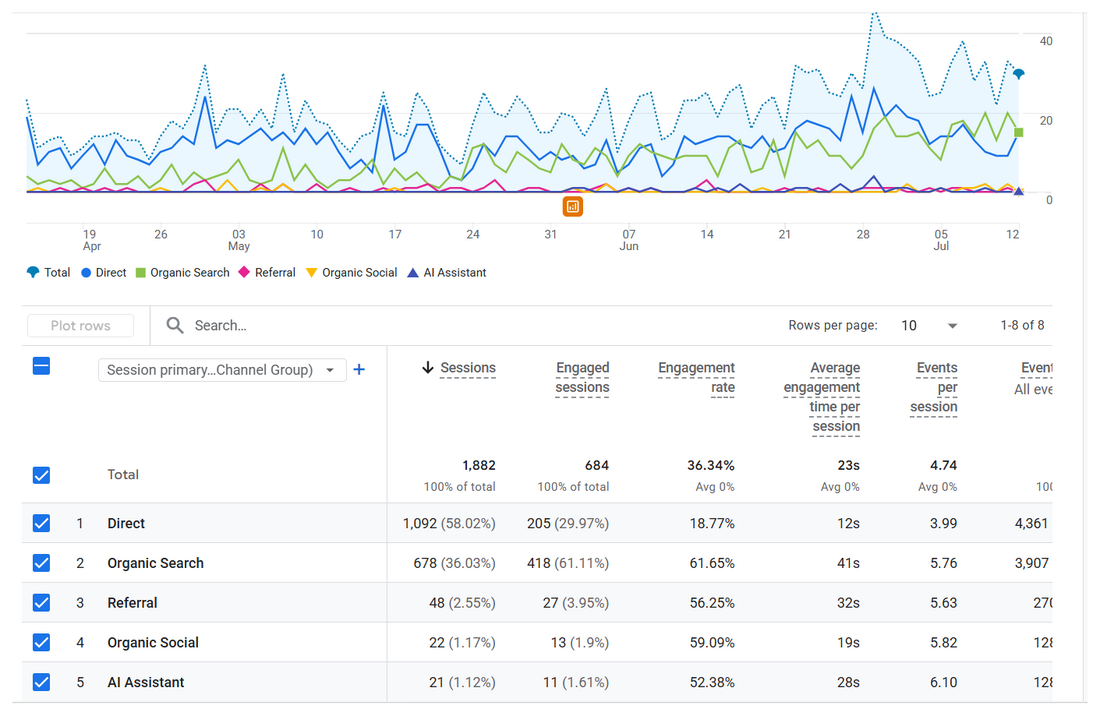
| Channel | Sessions | Share | Engagement rate | Avg. time |
|---|---|---|---|---|
| Direct | 1,092 | 58.0% | 18.8% | 12s |
| Organic Search | 678 | 36.0% | 61.7% | 41s |
| Referral | 48 | 2.5% | 56.3% | 32s |
| Organic Social | 22 | 1.2% | 59.1% | 19s |
| AI Assistant | 21 | 1.1% | 52.4% | 28s |
88% of all new-visitor discovery came from search
Direct traffic is mostly existing members and word-of-mouth returning to the site — it does not grow an audience. Look only at the channels that find new people (search, referral, social, AI) and organic search is 88% of them. On a platform with no blog, that entire discovery layer simply does not exist on your own domain.
The traffic search brings is also the best traffic
Organic was not just the biggest discovery channel — it was the highest quality. A 61.7% engagement rate versus 18.8% for direct, and 41 seconds of average engagement versus 12. The visitors Google sends stay longer and do more. The channel your current platform cannot give you is also the one that converts best.
They are showing up in AI answers, too
Notice the "AI Assistant" channel — real sessions arriving from ChatGPT and Perplexity citing the studio's pages. AI search engines can only cite content that exists as crawlable pages. No blog, no citation. A platform without an editorial surface is invisible to the fastest-growing discovery layer on the internet.
Why Uscreen and Vimeo OTT structurally can't do this
This is not a content-effort story — it is an architecture story. Uscreen has no blog feature, so its customers who want to rank run a separate WordPress site and embed the video player as a sidecar: two platforms, two domains, two bills, and split SEO authority. Vimeo OTT is worse — a sitemap frozen since 2014 and no page-level SEO. On either platform, the growth channel above cannot exist on your own domain, no matter how good your content is.
The takeaway
Migrating platforms is not about saving a few dollars a month. It is about adding a compounding, free acquisition channel that your current platform blocks by design — one that also happens to bring your highest-engagement visitors and get you cited by AI. Ninety days was all it took here. See how CrocOTT compares, or read the Uscreen migration guide.
Related case study: a yoga membership moved its entire 250-class library off Uscreen onto a platform it owns — the full cost breakdown and the five limits that made them leave.
Frequently asked questions
Can you get organic search traffic on Uscreen or Vimeo OTT?
Not on your own domain in any meaningful way. Neither platform includes a blog or editorial pages for search engines to index. Uscreen has no blog feature at all, and Vimeo OTT ships a sitemap frozen since 2014 with no page-level SEO. Creators who want to rank end up running a separate WordPress site and embedding the player as a sidecar. On CrocOTT, video, subscriptions, and a search-optimized blog live on one domain.
How long does it take to grow organic search traffic on CrocOTT?
In this case study, a studio with about 500 members grew organic search from a sliver of traffic to the site's number-one discovery channel in roughly 90 days, reaching 36% of all sessions. SEO compounds: unlike paid ads, the traffic keeps growing after the content is published and does not stop when you stop paying.
Why is organic search traffic more valuable than direct traffic?
Direct traffic is mostly existing members returning, so it does not grow your audience. Organic search brings new people actively looking for what you offer. In this study organic search also had far higher quality: a 61.7% engagement rate versus 18.8% for direct, and 41 seconds of average engagement versus 12.
Do I need a separate website for SEO if I use CrocOTT?
No. CrocOTT hosts your video, subscriptions, and blog on a single domain, so the content that ranks on Google lives on the same site as the player it sells. This is the opposite of Uscreen, where customers who want organic traffic run a separate WordPress and embed Uscreen as a video sidecar — a fractured stack with two domains and two bills.